
What Is a Class Action Lawsuit?
A class action lawsuit is one court case brought on behalf of everyone harmed the same way by the same company. You do not sign up to join it. If you fit the class definition you are already a member, and the step that pays you is a free claim form after the case settles. Below, what that looks like across 115,742 people and 136 settlements we track.
Quick answer: A class action lawsuit is one case brought by a few named plaintiffs on behalf of everyone harmed the same way by the same company. A judge must certify the class first. If you fit the class definition you are included automatically, with no sign-up, and you get paid by filing a free claim form before the deadline. Typical consumer payouts run $20 to $500 per person.
The definition, in plain English
Class actions solve a specific problem: a company overcharges ten million people $30 each. That is $300 million of harm, but no individual has $30 worth of reason to hire a lawyer. A class action bundles those claims into one case so the math works.
In federal court the rules live in Rule 23. Before a case proceeds as a class action, a judge must certify it on four requirements:
- Numerosity. The group is too large to sue one by one.
- Commonality. The group shares questions of law or fact.
- Typicality. The named plaintiff’s claim looks like everyone else’s.
- Adequacy. The plaintiff and their lawyers will fairly represent the class.
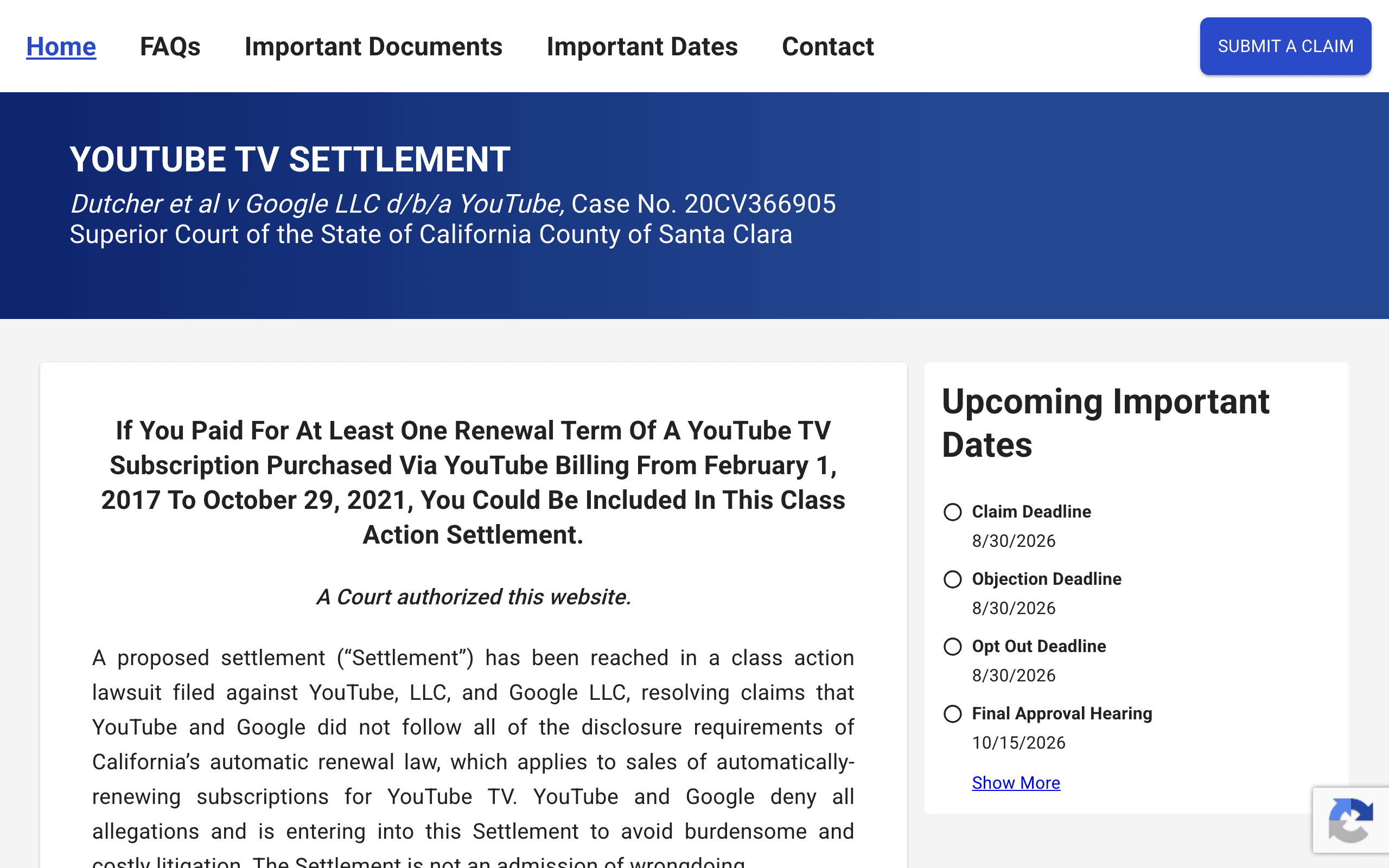
Here is the part most people miss: the class is defined by a description, not a sign-up list. This real settlement site spells its description out, and if that sentence describes you, you are in the class whether or not you have ever heard of the case.
How a class action works, start to finish
Most of a class action is invisible to class members. Cases take one to three years from filing to settlement, and during that stretch there is nothing for you to do. The five minutes that matter come at the end.
Case settles
Court approves a fund
Claim window opens
Administrator posts the form
You file
About 5 minutes, free
Deadline closes
Final approval hearing
You get paid
Typically 3 to 12 months later
The gap between the claim window opening and the deadline closing is the whole opportunity, and it usually runs 60 to 120 days. Administrators must make reasonable efforts to notify class members, but notice goes to addresses companies often no longer have.
The clearest number we have: of the 84 settlements in our catalog with a fixed claim deadline, 72 have already closed. Only 12 are open today. A settlement is not a standing offer, it is a window, and most of the time you are looking at one that shut.
That is the real mechanism behind unclaimed settlement money. It is rarely that people weighed a $40 claim and decided against it. They found out in month nine of a four-month window. See how to never miss a deadline and how long settlements take to pay.
What a real settlement looks like
Every legitimate settlement gets a court-authorized website run by the claims administrator. They look remarkably alike: the eligibility question up top, the fund size, a claim form, and the court documents behind it. These three are open right now.
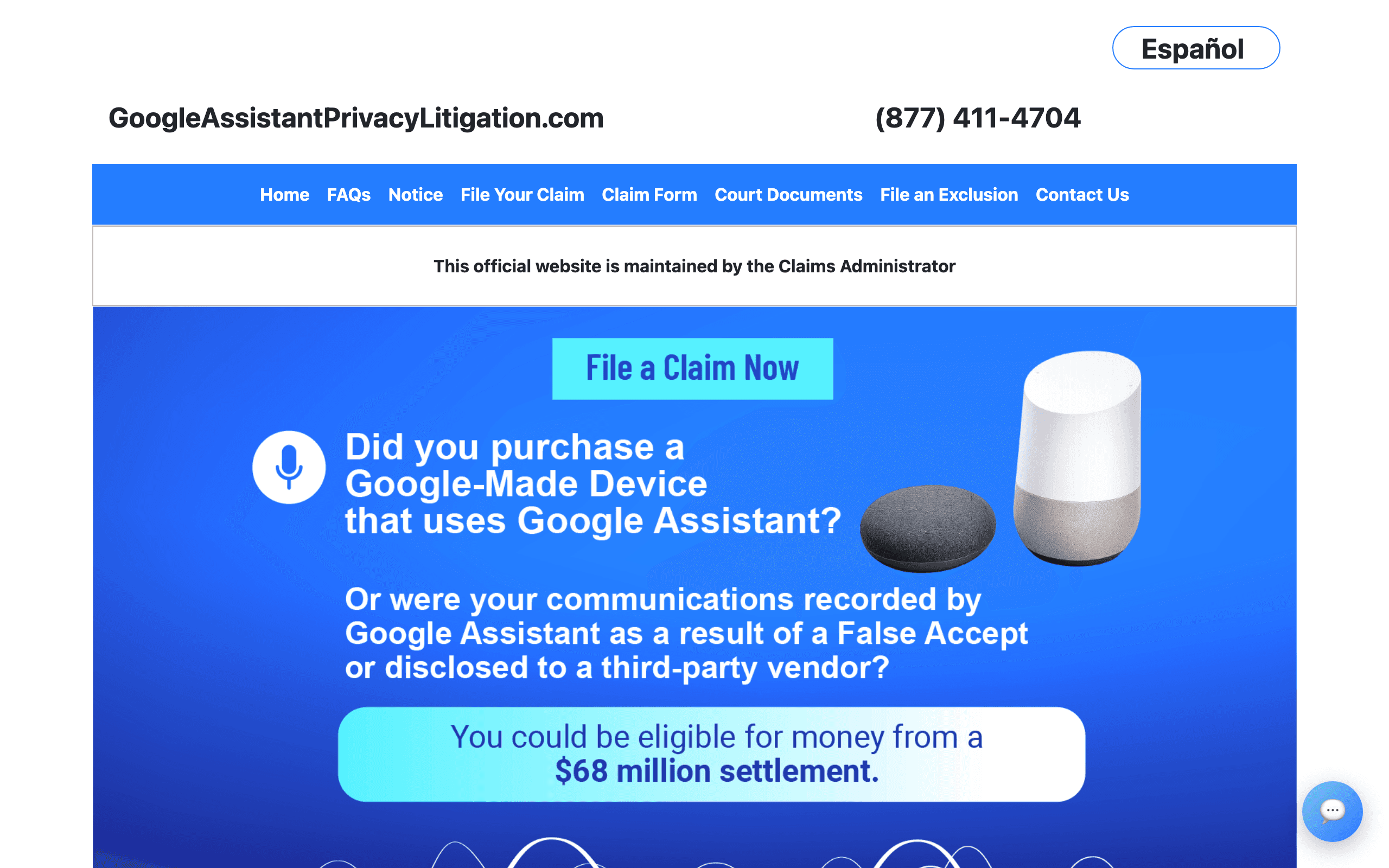
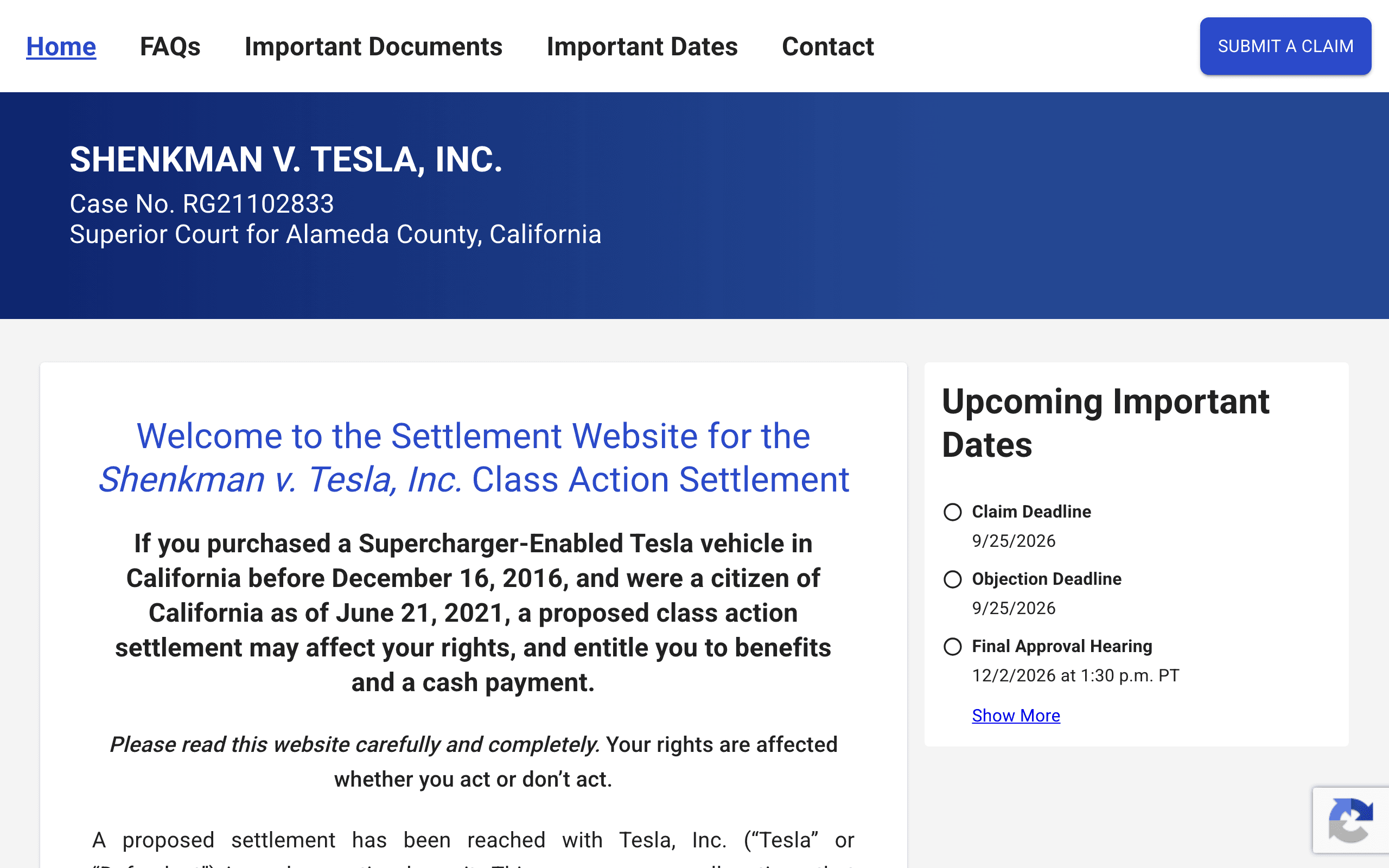
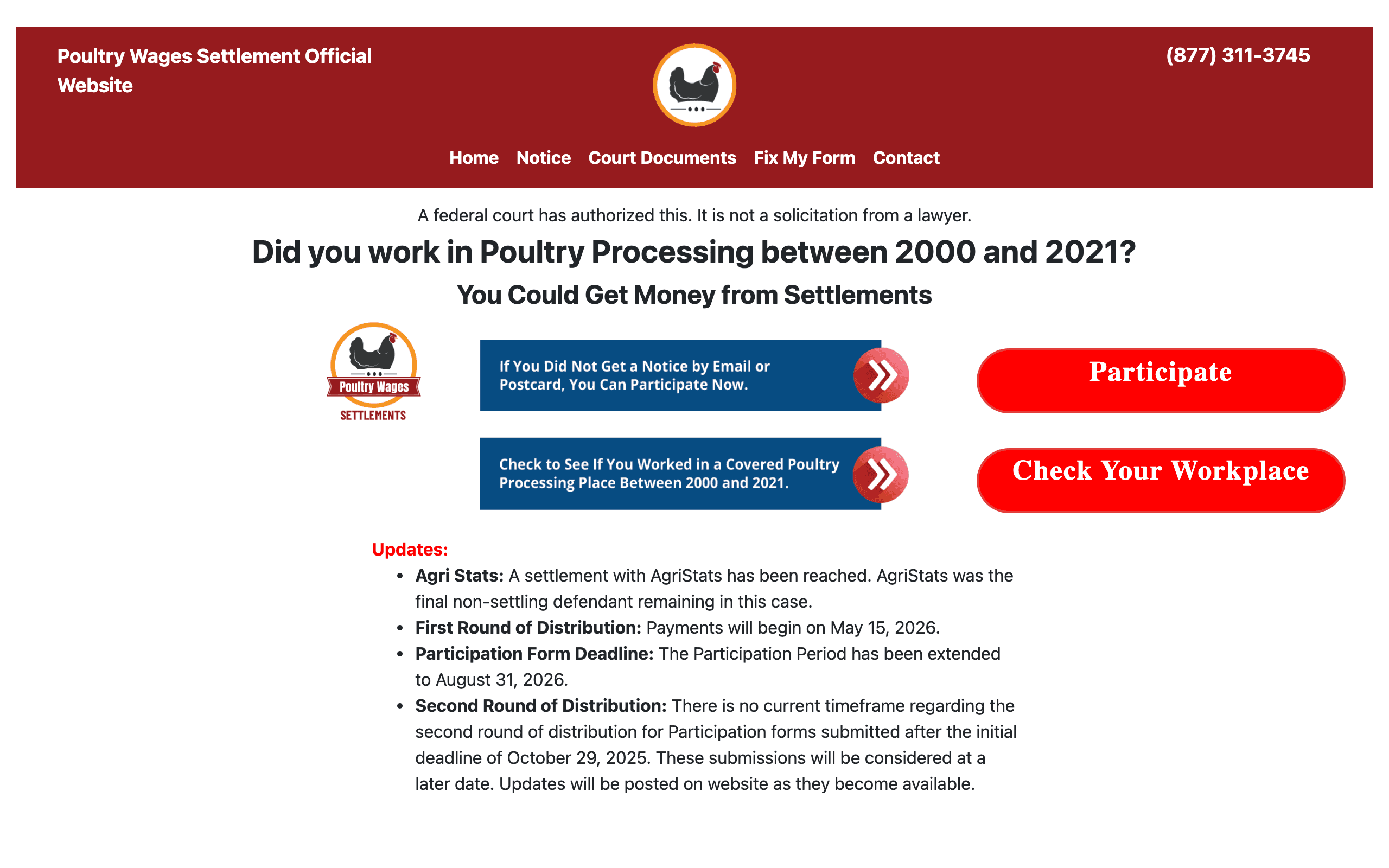
Anything asking you to pay a fee, buy something, or hand over a full Social Security number to receive money is not the administrator. Our guide to telling a real settlement notice from a scam covers verification.
What consumer class actions are actually about
People picture class actions as defective products and injuries. In the catalog we maintain, that is barely represented. Sorting 95 categorized settlements by claim type gives a different shape:
The 95 categorized settlements in Payout’s catalog, by claim type.
Privacy and false advertising dominate: 39 and 36 of the 95 categorized settlements. That matters practically, because both describe things that happen to you invisibly. You know if a product injured you. You do not know that an app shared your data with a vendor, or that a label overstated what was in the bottle, until a lawsuit says so. Add overbilling and those three categories account for the large majority of the catalog: conduct a person would never independently notice.
That is also why eligibility is broader than people assume. Cases like the Google Assistant privacy settlement or the beef price-fixing settlement sweep in anyone who owned a device or bought groceries in a date range.
Who actually gets the money
This is the most common suspicion about class actions, and it deserves a straight answer: the lawyers take a large cut, and class members still get the majority. Fees typically run 25% to 33%, and a judge must approve them.
| Where the fund goes | Typical share | Who decides |
|---|---|---|
| Class members who file claims | 60% to 70% | Split among valid claims |
| Attorneys’ fees (class counsel) | 25% to 33% | Judge must approve |
| Administration and notice costs | 2% to 8% | Court-appointed administrator |
| Service award to named plaintiffs | Usually under 1% | Judge must approve |
One consequence is counterintuitive: the member share is divided among people who actually file, so low participation concentrates the fund among claimants rather than saving the company money. When almost nobody files, leftovers can revert to the defendant or go to a nonprofit under a cy pres provision, which is why unclaimed settlement money is a recurring story.
What it actually pays a real person
Headlines quote fund sizes: a $100 million settlement, a $725 million settlement. Those say almost nothing about your check, because the fund splits across a class that can run into the tens of millions. The number that matters is the per-person range:
Each bar spans the reported per-person range. Same data as the table above.
Class actions are a volume game. People who reach $1,000 or more do it by qualifying for many settlements, not one big one. Two things move your number up: documented tiers pay more than flat no-proof tiers, so a receipt is worth digging for, and no-proof settlements (46 of the 136 cases we track) cost nothing but a few minutes.
How many people actually claim
Being in a class and getting paid are different things, and the gap between them is enormous. Here is every Payout account, grouped by how many settlements each person has claimed:
Every Payout account (115,742 people), grouped by how many settlements they have claimed.
Of 115,742 people, 27,062 have filed at least one claim. That is 23.4%, in a population that specifically downloaded an app for finding settlements. Among the general public, participation is far lower still, which is the whole reason settlement funds go unspent.
The other half of the picture is the long tail on the right. Once someone files a first claim they rarely stop at one: claimers average 2.9 settlements each, 190 people have filed more than 20, and the most claimed by a single person is 53. Nobody is eligible for 53 settlements by bad luck. It reflects how ordinary the qualifying conduct is once you are actually looking: a phone, a bank account, a few subscriptions, and a decade of normal purchases.
Aggregate, anonymized figures from Payout’s own user base and settlement catalog, computed August 5, 2026. They describe Payout users, not the general population, and claim counts are self-reported in-app. Payout does not guarantee eligibility, approval, or amounts. Per-settlement breakdowns are in our settlement statistics analysis.
Class action vs. mass tort vs. suing on your own
News coverage uses these interchangeably. The distinction decides whether you need a lawyer at all:
| Class action | Mass tort | Individual lawsuit | |
|---|---|---|---|
| Typical harm | Small, identical | Serious injury, varies per person | Specific to you |
| How you take part | Automatic if you fit the class | Retain a lawyer, file your own claim | Retain a lawyer |
| Need a lawyer? | No | Yes | Yes |
| Typical recovery | $20 to $500 | Thousands to millions | Depends on damages |
| Examples | Data breaches, hidden fees, false ads | Defective drugs and devices | Contract disputes, personal injury |
The dividing line is whether everyone’s harm is the same. Ten million identical $30 overcharges make a clean class. Ten thousand people injured by one drug in ten thousand different ways cannot be tried together, so those become mass torts, where each plaintiff keeps a separate claim and needs their own attorney. Payout covers the first column only.
What you give up by staying in
Class settlements come with a release. Accepting one nearly always waives your right to sue that company individually over the same conduct. For a $30 overcharge, trading a lawsuit you were never going to file for a $30 payment is straightforwardly good. If you were seriously harmed, the math changes.
Opting out is a real option with its own deadline, listed in the same notice as the claim deadline (you can see all three dates in the YouTube TV screenshot above). It is also the one decision here where talking to an actual lawyer is warranted. More in the legal risk of filing a claim and whether settlement money is taxable.
How to find out if you are in one right now
Because membership is automatic and notice is unreliable, the only way to know is to check class definitions against your own history. By hand, that means reading the open settlement list and filing before each deadline: start with open class action settlements or lawsuits you can join right now. For how a settlement works once it exists, see what is a class action settlement.
The reason most people never claim is not that they weighed the money and passed. It is that nobody told them the case existed while the window was open. Payout tracks 136 settlements, matches new ones against your profile, and has sent 58,891 alerts telling people a settlement just went live.
It is free, takes no cut of your payment, and is a discovery app rather than a law firm. You still file with the official administrator either way.